~ Elmore County
~
Elmore
County was established
February 7, 1889, with its county seat at Rocky Bar. Named
for the Ida Elmore mines, the area’s greatest silver and gold producer of the
1860’s.
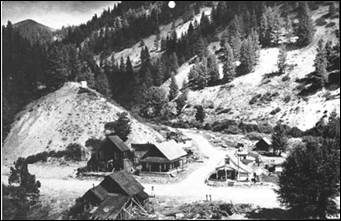
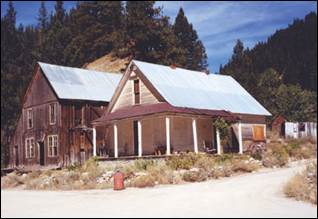
Rocky Bar, now a ghost town in Elmore County,
was founded in December 1863 soon after gold was discovered along the nearby Feather River. Within two years it became the main
settlement in the area and was even considered as a possible capital for Idaho Territory.
At its height in the late 19th century Rocky Bar boasted a
population of over 2,500 and served as county seat of Alturas County
from 1864 to 1882. It was also the original county seat of Elmore County
when it was created in 1889.
Rocky Bar is a ghost town in Elmore County.
At its height in the late 19th century Rocky Bar boasted a population of over
2,500 and served as county seat of Alturas
County from 1864 to 1882.
It was also the original county seat of Elmore County
when it was created in 1889.
(Alturas
County was a county in Idaho Territory
and later the state of Idaho
from 1864 to 1895. It covered an area larger than the states of Maryland, New Jersey,
and Delaware
combined. Most present-day southern Idaho
counties were created at least in part from the original Alturas County
area. The name Alturas comes from a Spanish word for “mountain summits” or
“mountainous heights.”
Alturas
County was created by the
Idaho Territorial Legislature in February 1864. Later that year the mining camp
of Rocky Bar was designated the county seat. The county seat was moved to
Hailey in 1882.
In 1889, the Idaho Territorial Legislature
created Elmore County
and Logan County
from parts of Alturas
County. On March 5, 1895,
to circumvent a recent state Supreme Court decision striking down an earlier
county reorganization, the Idaho Legislature combined Alturas and Logan
Counties into a new county called Blaine.
Two weeks later on March 18, the southern portion of the newly-created Blaine County
was split off to form Lincoln
County with its county seat
at Shoshone. Hailey remained the county seat of what was now Blaine County
and Alturas County
disappeared from the Idaho
map.)
Rocky Bar was founded in December 1863 soon
after gold was discovered along the nearby Feather River.
Within two years it became the main settlement in the area and was even
considered as a possible capital for Idaho
Territory. The town was
destroyed by fire in 1892. Although it was rebuilt, afterwards it began a slow
decline. Rocky Bar has not had a permanent population since the 1960s.
Rocky Bar is located 62 miles northeast of
Mountain Home.
Atlanta is an
unincorporated town in Elmore
County. It was founded in
1864 during the Civil War as a gold and silver mining community and named by
Southerners after a rumored Confederate victory over General Sherman in the
Battle of Atlanta, which turned to be wholly false, but the name stuck. While
the official website for the town indicates it was settled in 1863, the town
was not settled until 1864. Mining activity near Atlanta preceded its establishment as a
mining community. The John Stanley party discovered gold on the nearby Yuba River
on July 20, 1864, just two days prior to the battle back in Georgia. That November, John
Simmons made the discovery of the Atlanta
lode which contained both gold and silver.
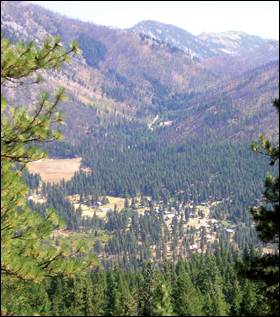
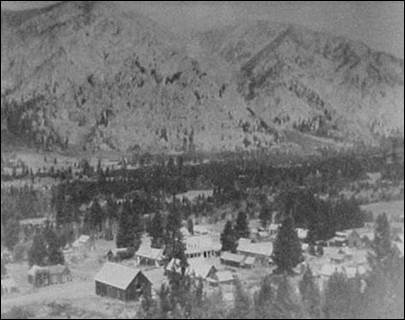
The town of
Atlanta, Idaho. Photo (above left) taken by John Hazlett
on 8/31/2005 from China Basin
Road, north of town. Atlanta, 1906 (above right) –
The early mining boom was over and at the turn of the 20th Century
the town had settled into a mountain community, hidden away in the Sawtooth Mountains. The only road in was over James Creek
from Rocky Bar and Featherville. There were stores,
saloons, and a brewery. Mining was still the main business. Greylock Mountain is in the background.
See “Atlanta, The First Gold & Silver
Discoveries” by John Hiler in March 2012
El-Wyhee Hi-Lites page 3.
Atlanta is at
an elevation of 5383 feet above sea level surrounded by the Boise National Forest,
located near the headwaters of the Middle Fork of the Boise
River, approximately 2 miles east of
the mouth of the Yuba
River. The Sawtooth Mountains are directly north, and Idaho City
is approximately 35 miles due west, as the crow flies.
Though founded as a mining community, and a
number of private claims remain in the area, no significant commercial mining
has occurred in the area for over 50 years, though more recently inquiries into
opening a new plant have seen some headway. In place of mining, Atlanta has diversified
into areas such as tourism, back-country activities, and preservation of the
town’s lengthy historic legacy.
During this early westward period the
majority of emigrants passed through Idaho on their
way to California or Oregon. Only a handful of pioneers settled
in Idaho and
they mostly were merchants who supplied the needs of the wagon trains. But in
the early 1860’s the discovery of gold in Idaho resulted in a population boom. For the
first time in our nation’s history a reverse migration eastward occurred. The California miners returned to Idaho
and Alturas County,
later to become Elmore
County. Alturas is a
Spanish name that means “mountain summit or heavens” and was one of the
original counties in Idaho.
Established on February 4, 1864, Alturas encompassed a huge area in southern
Idaho, extending from the north fork of the Boise River, south to the Snake
River, and from American Falls west to Indian Creek.
In the beginning years, the county’s
population was concentrated in what was known as the South Boise Mines,
including Rocky Bar, Atlanta Esmerelda and Junction
Bar. These early mining communities reflected the disruption of the Civil War
then raging in the East, making a mixture of people from all walks of life.
Some were petty thieves, shysters, and restless unfortunates who rushed from
strike to strike with visions of wealth bright in their eyes. Some were miners
from the earlier gold rush to Elmore Mining District in Alabama who went to
California as ‘49ers and then came to Idaho Territory, bringing their southern
names with them. Their influence is
evident in the names of a town, Atlanta
and gold mines the Jeff Davis, and
Southern Confederacy. Also participating in the early mining camps were
the Chinese. A census in 1870 showed that a large portion of miners were
Oriental. The Chinese miners were often willing to work for less, almost slave
wages, and had the reputation for being very industrious and clannish miners
keeping to themselves and living a frugal and healthy lifestyle.
When mining activities in the camps began to
show results the character of the mining camps changed. On the heels of the
prospectors came permanent settlers. The camps had attracted not only faro
dealers, bawdy houses, and dance hall girls but also merchants, lawyers, and
editors, men and women who were willing to endure the rugged life for the high
prices that their services could demand. The largest camps are now only ghost
towns, with only memories remaining.
By 1896 the district had produced 100,000
ounces of gold. But gold, silver, and other precious metals were not the only
things to come out of the Alturas mining camps. A wealth of western stories
involving shootings, hangings, and other assorted skullduggery were produced
during the heyday of the camps. The stories and characters were always full of
grit, courage, warmth, and perseverance.
Early farmers and ranchers arrived upon the
heels of the miners. Small ranches and farms began to spring up around the way
stations. The families settled on land near transportation routes and water.
Settlement was encouraged by the offer of up to 320 acres to each individual
who could make the required land improvements and locate water. This process
was called “proving up the land”. The ranchers and farmers continually expanded
operations to supply agricultural products to the booming mining communities.
Many farm and ranch families came to Elmore County
because of land schemes promoted by the railroad and land developers.
Promotional campaigns referred to Idaho as the
“Switzerland of the west”,
and Mountain Home as the garden spot of southern Idaho. Settlers were promised successful
crops, plentiful water, and a healthful climate. The claims, although exaggerated,
contained some truth. The land was rich, producing 3 to 5 times as many bushels
per acre as land in Illinois, Virginia, or Tennessee.
The land was also capable of producing a variety of crops, and prosperous
farmers invested in cherries, plums, apples, grain, cattle, horses, and sheep.
Cattle, horse, and sheep raising
became important industries in Elmore
County. By 1888 the
county had 35,000 cows, 60,000 sheep, and 8,000 horses. Wool and mutton
production rivaled the cattle and horse industry. Sheep adapted well to the
desert and high mountain ranges, although according to cattlemen they ruined
the ranges for grazing cattle. Conflict resulted between the Glenns Ferry cattlemen and the Mountain Home sheepherders.
The disagreements persisted until sheep production became more profitable than
cattle. From the 1890’s until after 1918 Mountain Home was one of the Horse
Capitals of the world and Kitty Wilkins was known everywhere as the “Horse
Queen of Idaho.”
Young Basque men from the Pyrenees Mountains,
between France and Spain,
provided the labor for the sheep industry. In their native land they had been
fishermen, craftsmen, and farmers, but in America, they turned their hands to
sheep herding and shearing. These Basque emigrants had a significant cultural
impact on Elmore County.
As the communities of Mountain Home and Glenns Ferry grew, Rocky Bar and Atlanta
declined the Alturas
County seat was changed
to Hailey as it was reached by the railroad in 1882. Almost immediately
residents began to push for a new county and the creation of Elmore County
was hotly debated. Finally, as its last act, the last Territorial Legislature
created Elmore County on February 7, 1889. The county
seat was first returned to Rocky Bar but soon changed to Mountain Home.
The period from 1890 to 1913 was known as the
growth years for the county. The completion of the Oregon Short Line (OSL)
railroad in 1883 allowed for the shipment of mining and agricultural products
to world markets. The outbreak of WWI intensified demand for these products;
especially wool that was used to manufacture military uniforms. The end of the
war also was the end of the agricultural boom. The slump that began in the 20’s
intensified during the Great Depression. Many small farmers and ranchers lost
their land. Economic conditions did not improve significantly in the county
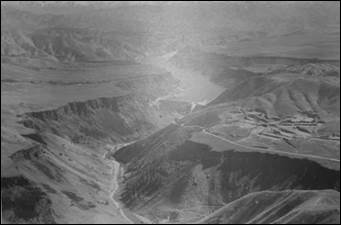
until 1941 when construction was begun on Anderson Ranch Dam, then the highest
earth-filled dam in the world and then with the outbreak of WWII crop prices
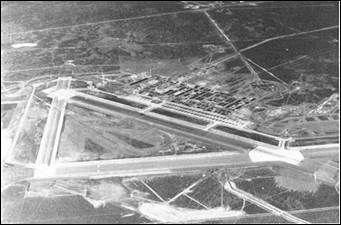
improved and construction of Mountain Home Air Force Base began.
|
|
|
|
Anderson Dam
|
Mountain Home
Air Force Base June 1945
|
The post-war era heralded permanent changes
in the character of the county. The mining industry had collapsed, cattle
replaced sheep, and farming exploded with the introduction of high lift pumping
and new technologies. The Air Base remained after the war, although it
de-activated for brief periods between 1945 and 1964. The base had a tremendous
impact on the community. First, it became the largest employer in the county.
Second, the influx of military personnel and their families resulted in a rapid
growth of population. Thirdly, business sectors grew to meet the needs of the
air base and its military family. And, finally a diverse military population
provided the community with a wealth of cultural diversities unique in the
state of Idaho.
Early settlers were attracted to Elmore County
because of the promise of unlimited opportunities. These opportunities still
exist today. And the future promises to be as exciting, turbulent, and
unpredictable as the past.
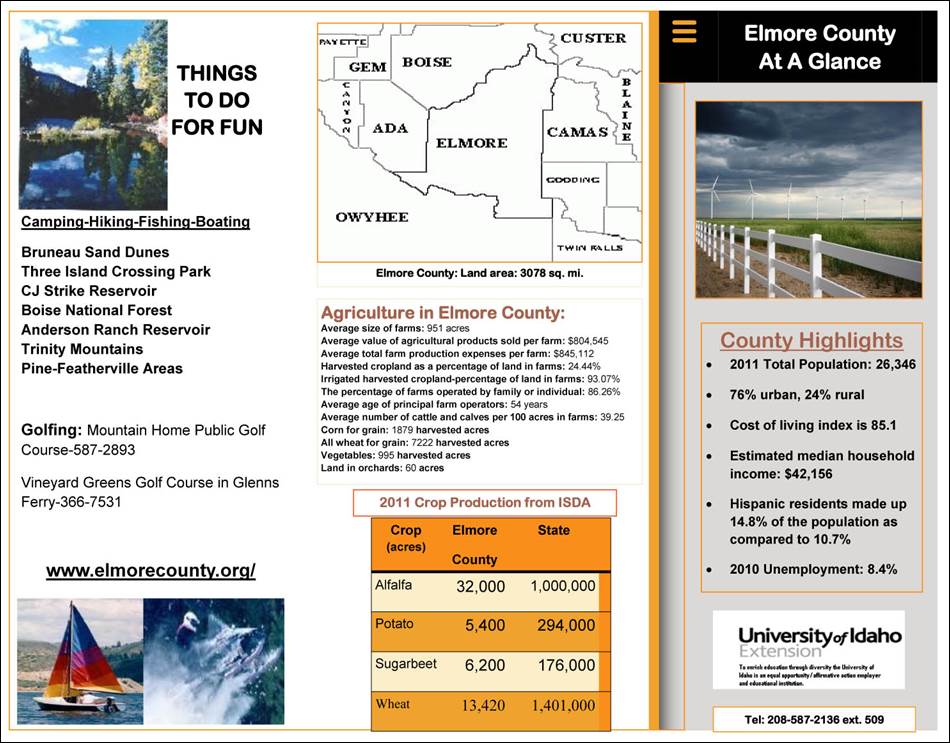
Elmore
County is located in Southwestern
Idaho. It is bounded on the north by Boise
County, on the east by Blaine, Camas, Gooding, and Twin Falls
counties, on the south by Owyhee County, and on the west by Ada County.
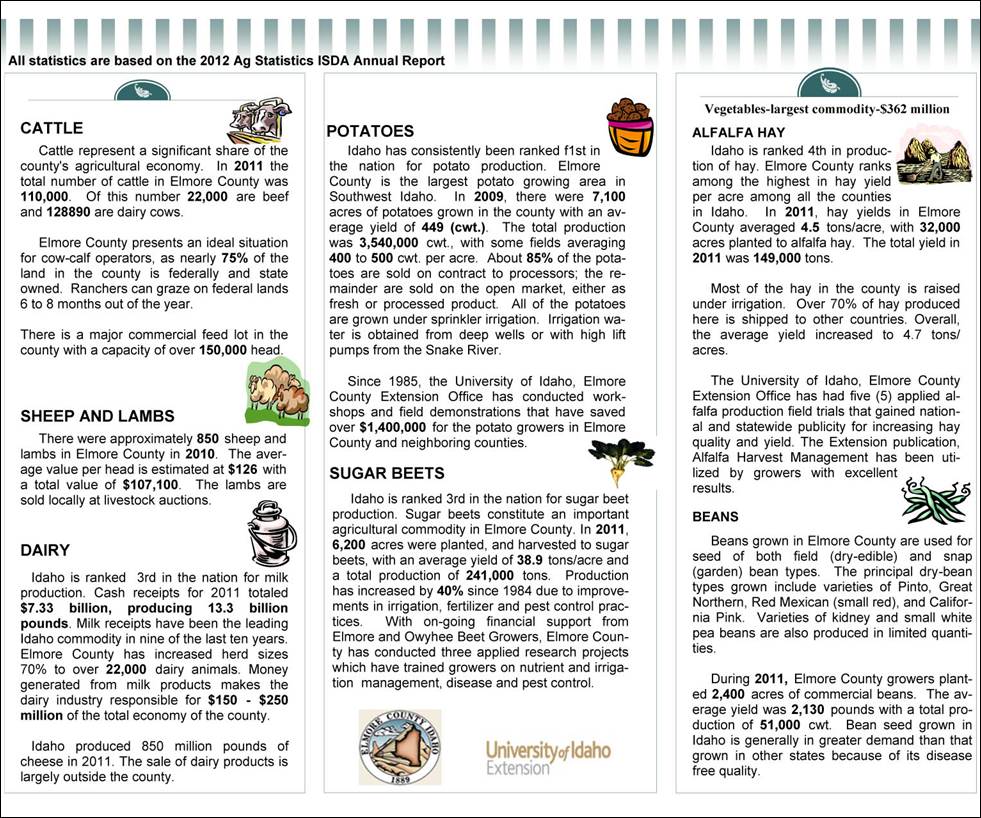
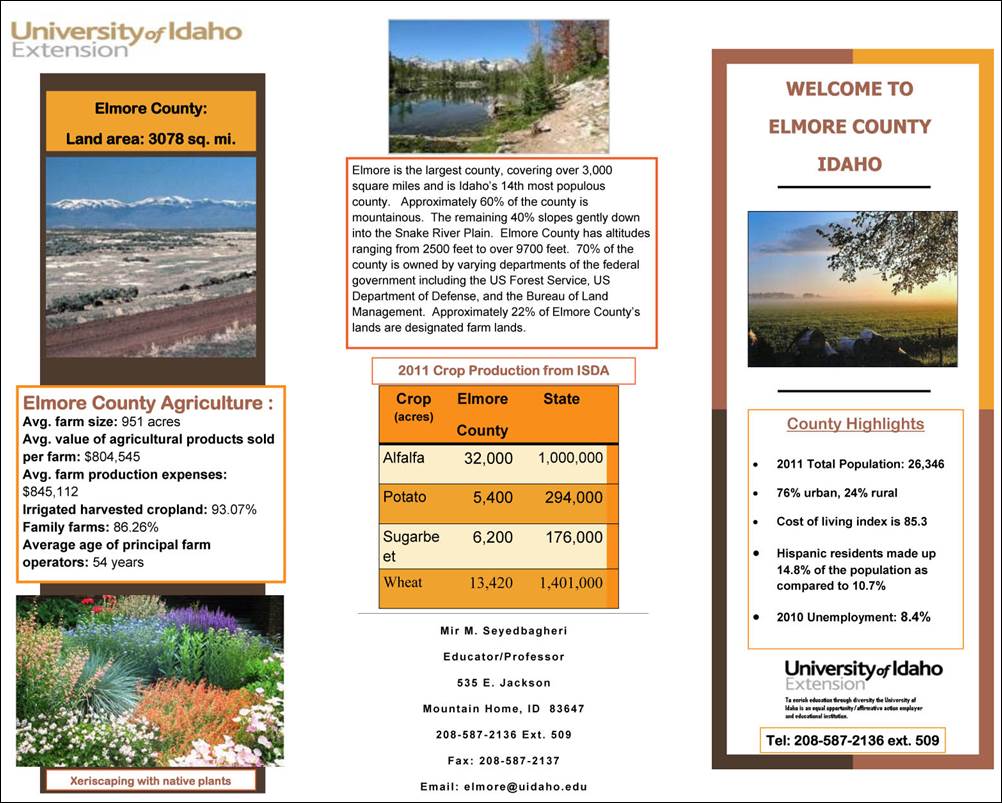
Elmore is a large county covering more than
3,000 square miles. Approximately 60% of the county is mountainous. The
remaining 40% slopes gently down into the Snake River
plain. Elmore County has altitudes ranging from 2500
feet to over 9700 feet. Seventy percent of the county is owned by varying
departments of the federal government including the U.S. Forest Service, the
U.S. Department of Defense, and the Bureau of Land Management. Approximately
22% of Elmore County’s lands are designated farm
lands.
The topography of Elmore County
is extremely varied, from low elevation plains to high, steep mountainous
terrain. The county is divided into two district provinces, the Northern rocky
Mountain Province-Idaho Batholith, and the Columbia Plateau Province-Snake
River Plain in the southern 1/3 of the county.
High glaciated mountains in the northern province, especially
the area north of Atlanta,
are dotted with several hundred glacial lakes. The terrain is very steep,
rocky, and rugged, and much is granite rock covered with alpine vegetation.
The Snake River Plain supports both irrigated
agriculture and spring-fall grazing for cattle and sheep. The major limitation
to further expansion of agriculture in this area is water. Soils also are a
limited factor in a few sections of the Snake River Plain.
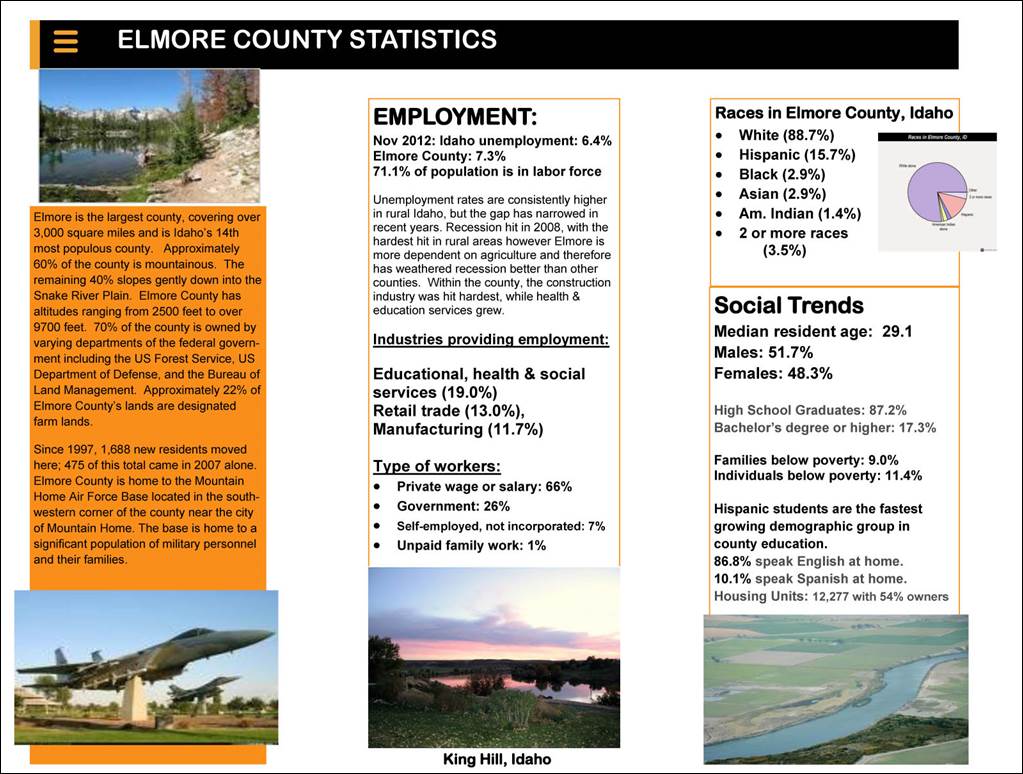
Elmore
County is Idaho’s
14th most populous county and ranks as the sixth largest in area of Idaho’s 44 counties.
Seventy-two percent of the county is federally owned. The county’s population
has experienced some ups and downs through the years but during the 10-year
period of 1997 to 2007 it increased by 6.2 percent, down from the 9.6 percent
recognized from 1996 to 2006. This increase amounts to 1,688 new residents
since 1997, 475 of this total came in 2007 alone. Elmore
County is home to the Mountain Home
Air Force Base located in the southwestern corner of the county near the city
of Mountain
Home. The base is home to a significant population of military personnel and
their families.
Cities in Elmore County:
Glenns Ferry & Mountain Home
Other
communities: Atlanta,
Featherville, Hammett, King Hill, Pine, Prairie,
Rocky Bar (ghost town), and Tipanuk. Mountain Home
Air Force Base, located 10 miles southwest of Mountain Home, is a military
community.
|
|
|
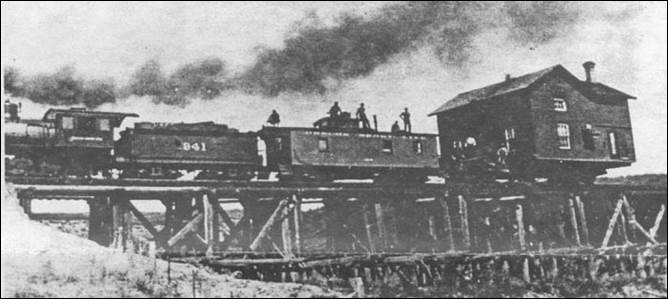
Back in
the early days they moved houses by use of the railroad such as this house
near King Hill.
|
Glenns Ferry was one of the most famous river crossings on
the Oregon Trail. Pioneers forded the Snake River at the Three Island Crossing until 1869, when
Gustavus “Gus” Glenn constructed a ferry about two
miles upstream, primarily to expedite freight but also for emigrants. His boat,
which could hold two wagons, cut nearly twenty miles from the former route.
|
|
|
|
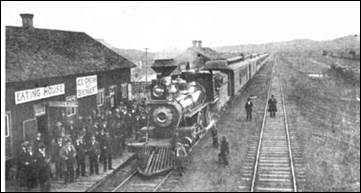
Glenns Ferry Rail Road Station
1889
|
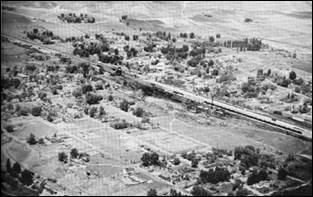
Early Glenns Ferry
|
Glenns Ferry History
Become a Facebook Fan of Glenns Ferry
Three Island
Crossing State
Park, opened in 1971, is home to The Oregon Trail History and Education Center, where visitors can learn about
pioneer emigrants and Native American history.
The townsite was
platted in 1871, just downstream from the ferry site, and the first bridge
across the Snake River was built here in 1908.
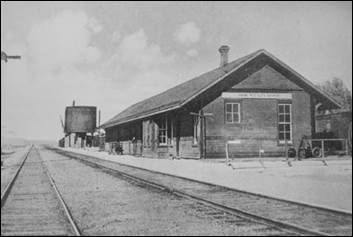
Mountain Home
originated as a stage stop (Rattlesnake Station, founded in 1864) for the
famous Overland Stages eight miles from its present location. When the railroad
(Oregon Short Line) came through in 1883 it brought with it a new mail delivery
service. The postmaster and stage agent, Jule Hage, packed up the post office and moved it down the hill
to the railroad. Along with him came the name and settlement of Mountain Home.
Mountain Home was incorporated as a village
in 1896. The initial village board consisted of A.B. Clark, R.F. Whitney, W.J.
Turner and G.F. Mahoney.
|

|
|
|
Mountain
Home pioneers
|
Mountain Home Rail Road Depot
|
Mountain
Home History
Mountain Home became a shipping and
distribution center for the livestock, mining and logging business.
When irrigation systems were built, with
the help of high-lift pumping and the construction of irrigation dams, the
agricultural industry became stronger and much of the desert land was opened to
farming. Thousands of acres of land could now produce grain, hay, sugar beets,
potatoes, and beans.
Livestock production and, more recently, the
dairy industry have also made a considerable contribution to the local economy.
Mountain Home has a current population of
approximately 14,600 and is a community of diverse cultures. It sets at an
elevation of 3,143 feet. The hottest month is July and the coldest is January.
Average annual precipitation is 10.7 inches.
Mountain Home is especially proud of its
parks, visitor’s center, golf course, and museum.
Being centrally located in Elmore County,
Mountain Home is referred to as “The Hub of Elmore County”.
Mountain Home Air
Force Base, located 10 miles from Mountain Home, was established during
the early stages of World War II. The Air Base would become one of the major
life lines for Mountain Home.
Prior to December 7th the War Department had
begun building Army Air Fields and Camps. With the beginning of the war the
schedule was accelerated and suddenly many small towns found that they were to
be the host of a large military establishment. This is exactly what happened to
a little town with a `940 population of 1,163, Mountain Home, Idaho
suddenly was a big player in winning the war.
Early in 1942 the base establishment
commission began looking at southern Idaho
for places to put Army Air Fields. They found one at Pocatello
and Gowen Field in Boise was authorized. Jerome, Idaho
was carefully reviewed for a base but the commission thought that land there
was too expensive at between $5 and $25 an acre. The commission came to
Mountain Home. The community was on the railroad main line and astride Highway
30. Meteorological records were reviewed and it was found that there was little
problem with bad weather or fog. Land was easily had for $.50 to $1.50 per
acre, the base could be removed from all encroachment, water was available from
deep wells and there was an abundance of Federal lands available for a large
training range. In short order a deal was struck and Gus Nelson and Father King
the local Catholic priest sold the US Army a large tract of land for about
$1.00 an acre. The Sagebrush desert was perfect for the long level runways to
be built for those airplanes that were still on the drawing boards waiting for
engines to power them into the sky. In a few weeks construction began.
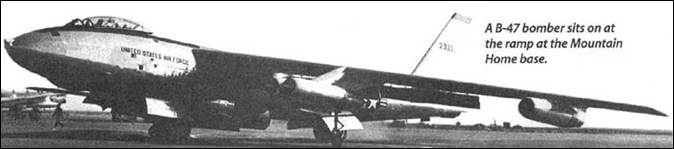
The photo above is of a B-47 Stratojet as it sits on the ramp at Mountain Home
AFB. A true jet bomber it
changed US
airpower and was designed and built to last almost forever. (photo
courtesy Mountain Home Air Force Base)

F-111F at Mountain
Home Air Force Base.
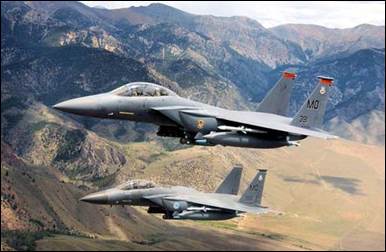
Mountain Home AFB F-15s in
flight.
Previous
names:
Army
Air Base, Mountain Home, Nov 1942
Mountain
Home Army Air Field, 2 Dec 1943.
Mountain
Home Air Force Base, 13 Jan 1948–Present
Source: Wikipedia, John Hiler, MHAFB, El-Wyhee Hi-Lites
# # #
El-Wyhee
Hi-Lites
_______________________________________________________________________
Elmore County
Veterans Service Officer
This is an appointed position by the Elmore
County Commissioners for the benefit of veterans and their families that reside
in Elmore County.
This position is filled four hours a day, five days a week for the
purpose to provide counseling, guidance and administrative assistance to
veterans, retirees, spouses and dependents of deceased veterans.
The Service Officer (Traci L. Colton) assists
in completing specific required VA and other governmental forms. She assists in writing statements in support
of claims for service and non-service connected disabilities, widow pensions,
registration for the Idaho State Veterans Cemetery, and health-care
applications for the VA Hospital and more.
The Service Officer is knowledgeable of
Federal Veterans Laws, Rules and Regulations that govern adjudication of claims
for VA benefits. She is familiar with
relevant statutes (Title 38 USC) and Regulations (38 CFR) that dictate how
claims and benefits are granted, case appeal procedures and appellate rights
and due process.
Monetary return has proven to be very
rewarding to the county. During the 2008
calendar year there was $6,204,825 returned to Elmore County. This amount was through several types of
monetary awards, such as disability compensations, widow pensions, burial
allowances, indemnity compensations and vocational rehabilitation. This substantial amount is a direct revenue
return to the community through the purchase of goods and services by our
veterans and their families.
On an average, the Elmore County Services
Office assists 21 veterans, retirees, surviving spouses and family members on a
monthly basis. The Service Officer also conducts
‘Outreach’ services and provides visits to the Pine/Featherville
area and Glenns Ferry.
The office has also set up a special program
for our wheelchair bound veterans, providing travel for their medical
appointments to the VA Hospital in Boise,
at no cost to the veteran.
This is an outstanding service provided to Elmore County
veterans and has turned into a real asset to residents. Ms. Colton’s office is located 515 East 2nd
South. Ms. Colton’s office number is (208) 587-2130, ext
1296, call for an appointment.
Topography of Elmore County
Elmore
County is located in Southwestern
Idaho. It is bounded on the north by Boise
County, on the east by Blaine, Camas, Gooding, and Twin Falls
counties, on the south by Owyhee County, and on the west by Ada County.
Elmore is a large county covering more than
3,000 square miles. Approximately 60% of the county is mountainous. The
remaining 40% slopes gently down into the Snake River
plain. Elmore County has altitudes ranging from 2500
feet to over 9700 feet. Seventy percent of the county is owned by varying
departments of the federal government including the U.S. Forest Service, the
U.S. Department of Defense, and the Bureau of Land Management. Approximately
22% of Elmore County’s lands are designated farm
lands.
The topography of Elmore County
is extremely varied, from low elevation plains to high, steep mountainous
terrain. The county is divided into two district provinces, the Northern rocky
Mountain Province-Idaho Batholith, and the Columbia Plateau Province-Snake
River Plain in the southern 1/3 of the county.
High glaciated mountains in the northern province, especially
the area north of Atlanta,
are dotted with several hundred glacial lakes. The terrain is very steep,
rocky, and rugged, and much is granite rock covered with alpine vegetation.
The Snake River Plain supports both irrigated
agriculture and spring-fall grazing for cattle and sheep. The major limitation
to further expansion of agriculture in this area is water. Soils also are a limited
factor in a few sections of the Snake River Plain.